Showing posts with label Pola. Show all posts

Sunday, March 27, 2022

$1 Die Craft

For the first time since 2019 I attended a swap meet, and like swap meets of yore, there was a smattering of E. L. Moore lineage stuff for those in the know. Ok, well, that means me :-)

I saw this assembled Life Like Die Craft Manufacturing Company, a variation on the Schaefer Brewery kit, for sale for $1CDN (80¢ US).  Even though it's missing a few parts, I couldn't argue with the price and bought it.

On the base's bottom is stamped: Life Like, Made in Western Germany. I suspect it was manufactured by Pola.

After looking the rest of it over it is indeed made from the old Schaefer Brewery molds. I'm not sure what I'll do with it, but I think it'll eventually find a place on the new layout.

Saturday, October 31, 2020

Pola's American Designer Series kit building contest

In the September 1983 issue of Railroad Model Craftsman this Pola ad appeared for a new contest they were holding. All you had to do was build any of their kits that had the American Designer Series eagle sticker on it (it's the eagle image shown in the ad), and send them photos of your finished project. Box-stock or kitbashed, HO or N scale, it didn't matter as long as the photos make our kits look good. They were going to announce two winners every month (1 for MR and 1 for RMC) until June 1984. 

This ad doesn't identify any more of their kits that were designed by famous American model railroaders as did their previous one. But, maybe the months leading up to June '84 will.

A comment was posted on my earlier story about the American Designer Series that the price of E. L. Moore's Grusom Casket kit seemed rather high at $19.98. I couldn't find another ad to confirm the price, but I did find the following Model Power ad for the E. L. Moore Brewery in the Jan '83 issue of RMC


Model Power had changed the brewing company to Budweiser, and the price was listed as $8.00. In the Pola contest ad they note that one of their kits suitable for entry was #806, Brewery. That is the same E. L. Moore brewery kit, and they were listing it for $15.00, which is getting close to double Model Power's price. An internet inflation calculator tells me that $15US in 1984 is today about the same as $37.50US.

It looks like my trek to June 1984 is going to be an interesting one. Stay tuned!

Thursday, October 29, 2020

Pola's American Designer Series

I was quite surprised to see this Pola ad in the November 1982 issue of Railroad Model Craftsman

It starts off by stating: Pola manufactures over 200 HO & N structure kits. Many of these are American designs originally published in MRR (their acronym for Model Railroader) and RMC. We are re-issuing these on a limited basis, at special prices. 

Amongst the pictures it notes that the coal mine in the upper left is a Jack Work design from a 1959 issue of Model Railroader, although it doesn't say which issue. And in the lower left there is the good old Grusom Casket Co. from an E. L. Moore design in Railroad Model Craftsman. It doesn't say who designed that coaling station in the lower right, but the overall implication is that it came from somewhere in the pages of MR or RMC. I wonder if these were released in special American Designer Series boxes, or if there are any further ads with more about this series? An interesting twist. The search continues :-)

[30 October 2020 update: Vince informs me, and I confirm, that the Jack Work coal mine article was actually a 3-parter that appeared in the Oct, Nov, and Dec '59 issues of MR. And, the same ad also appeared in the Nov. '82 issue of MR.]

Saturday, June 27, 2020

A relation in Germany?

Old Machine Factory by Auhagen
While Martin was searching for Grusom Casket kits he came across this beautiful model by the German company Auhagen. I must admit the overall form and arrangement are indeed reminiscent of the AHM / Pola Grusom Casket kit as Martin pointed out to meNot to mention that the kit's name has 'machine factory' in it, and a spin-off from Grusom Casket was a 'machine shop'. And, Grusom Casket was originally manufactured by Pola of West Germany. Was Grusom Casket chosen to be manufactured by Pola because it had some similarity to a German building type that suggested the kit could be successfully marketed in Germany and elsewhere in Europe as well as the US? Interesting speculations aside, I can't draw a direct connection with Grusom Casket. But, as I've said before, the similarities are similar :-)


Repair Shop by Auhagen
Well, there's one other thing. Auhagen is also marketing the one storey part as a separate kit - the Repair Shop in the photo on the right - which is what AHM did with the 'machine shop' end of Grusom Casket. As well as the Repair Shop there is also a red brick variation in their Gas station with a car workshop kit.

Much thanks to Martin's eagle eyes for finding these kits! I continue to be amazed by what's out there.

Tuesday, June 23, 2020

A side order of Machine Shops

If you've been following along with the Machine Shop boxing saga you know there were many variations. 

I find this view of Martin's collection of several of those boxings quite interesting. Over on the left are the original AHM and Pola boxings. On the far right is the last boxing, the one from Walthers. I'm not quite sure just yet what the order should be for the other boxings, but it's interesting that the kit box went from a lively little offering with a colourful painting on the lid to a much larger box in a bland, utilitarian style (the Walthers site says it's now out of stock and discontinued). In his Machine Shop journey Martin has found a number of other kits that bear some resemblance to the Machine Shop - although they don't appear to be derived from it - and I hope to post some pictures of them in the days ahead.

Tuesday, June 9, 2020

Grusom boxes

You'll need to click on the image to enlarge it in order to follow the discussion, but trust me it's worth it :-) 

Here are two different boxings of E. L. Moore's Grusom Casket kit. Both have a diagonal red box printed on that reads: Reproduced by permission from plans as shown in Railroad Model Craftsman. Now things get a little odd. The one on the left was recently acquired by Martin. Notice the red, apparently typewritten text that says, by Mr. E. L. Moore. The one on the right is from my stash. It has a second red box printed on that reads: PROJEKTIERT VON MISTER E. L. MOORE. I assume mine was meant for sale in West Germany, and Martin's was for the North American market. I thought Pola was selling these kits in West Germany; however, the box suggests AHM was too. More catalogue investigation is needed.

Wednesday, June 3, 2020

Plans

I was fortunate in that the AHM Brewery also included the plans. In the photos the AHM plans are on the right, and those for the Model Power version are on the left. The AHM kit was manufactured by Pola in West Germany, and the kit was simultaneously released by Pola for the European market and AHM for North America. The Pola / AHM plan is wordless so there was no need to create versions in different languages. I assume this was done to keep costs down. The modern day Model Power plans seem overly busy, and I'm not a big fan of instructions that shout at me in ALL-CAPS.

Monday, May 25, 2020

Beer & Pickles

A well disguised F&M Schaefer Brewery
I was reviewing the instructions on how to build the Perry Schibbel Fruit & Co-Op in Art Curren's book Kitbashed HO Model Railroad Structures, and found that the table in the back listing kit substitutions that could be used for the various projects noted Model Power 's Heinz Pickle Factory, kit #465, could be substituted for AHM's F&M Schaefer Brewery, the E. L. Moore designed kit that the kitbash is based on. The only difference being that the pickle factory has wood sides, not brick as does the brewery. 


Left: Pickle Factory; Right: Brewery
Martin generously sent me a photo of the pickle factory's walls, and when compared to the brewery walls in my Model Power repop, well, you can see the basic shapes are indeed the same. Ok, one has square openings, and the other has arched, but Mr. Curren was right, you could no doubt build a wooden version of Schibbel's. The pickle factory is just a 'wooden' version of the brewery.

As with many of these kit buildings a few other manufacturers sold this pickle factory. There's a Pola version and a Lionel, and probably others, but the key thing is that this is yet again another kit that can be traced back to E. L. Moore. 

Monday, May 18, 2020

Machine Shop '73

Martin noted that the machine shop that appeared as a new product in Pola's '72 catalogue, appeared in AHM's '73 catalogue. You can see that AHM used the same painting Pola did. I wonder if there was a '72 AHM catalogue, or if their '73 catalog was published late in '72 - say, in time for Christmas - because I'd like to narrow down the date when the kit became available in North America. Well, on the other hand, given where we are in the 21st century, it hardly matters much if it was released 47 or 48 or even 47.5 years ago, the fact that it's had the life and longevity that it did is amazing in and of itself.

Sunday, May 17, 2020

The Smithy Arrived In '75

Another find in the Pola catalogues: apparently E. L. Moore's Smithy was a new Pola product in 1975 according to that year's catalogue

And if that wasn't enough, it was also featured on the cover!


New for '72

I've been browsing through these Pola catalogue scans and came across that image from their 1972 combined HO / N catalogue. Obviously from the 'neu' the machine shop was a new release for 1972. AHM was the North American distributor for the E. L. Moore kits so I need to find an equivalent entry in an AHM catalogue.

Saturday, May 16, 2020

From Machine Shop to Benzene Separation Plant

I think the 30Squares Media Empire is going to have to open an E. L. Moore research centre in England to supplement those in Virginia, Toronto, and Ottawa - not to mention all the great leads sent by readers worldwide - given all the excellent information Martin is sending me. This fascinating Pola 'Benzolabscheidung', which Google Translate tells me means 'Benzene Separation'*, that Martin found is clearly another variation on E. L. Moore's AHM Machine Shop kit. But, there's a little twist in this version: it looks like the back wall has been replaced with a front wall casting, and clearly the tar paper roof has been replaced with what looks like a tile job and a dangerously tilted chimney - well, I can't quite make out the roof covering, but it clearly isn't tar paper and skylights. I've said it before, and I'll say it again, it's amazing the number of E. L. Moore kit variations there are out there.

*Benzene separation? OMG I hope that isn't some kind of residence behind the plant, and is that yellow double-decker bus in the background dropping off people nearby? Benzene is nasty stuff. Years ago I worked in a lab doing research on ways to separate oil from tar sands, and benzene was one of the solvents tested. We had to wear all kinds of serious PPE and follow very strict lab protocols for handing the stuff. I gave up chemistry after that and tried to find a sedate desk job where paper cuts and eye strain would be my main worries. I would not want to see how benzene is being handled in a re-purposed machine shop :-) 

Tuesday, May 12, 2020

Schaefer Brewery becomes Die Craft Manufacturing Company

You may remember Martin's eagle-eye spotted that Pola's Schilling Iron Casting was actually a variation on the AHM kit of E. L. Moore's Schaefer Brewery. He's done it again and thoughtfully alerted me :-) You can see that Life-Like's Die Craft Manufacturing is a re-boxing of Schilling Iron Casting, which itself is a reconfiguration of the elements of the E. L. Moore designed AHM Brewery.  This Iron Casting / Die Casting company is an interesting variation as there aren't the usual clues to its heritage. It's only after an examination of the images and parts is it clear who its ancestor is. 

Thursday, March 19, 2020

Schaefer Brewery becomes Schilling Iron Casting

Boxtop photo generously provided by Martin from his kit collection
Martin kindly got in touch and told me about this kit in the Pola Quick series (kit # B 818), which is clearly a variation on AHM's E. L. Moore designed Brewery model (kit # 5813). Pola doesn't appear to have named this product, but when I translate the sign on the box top painting using Google Translate I get: Fritz Schilling & Son Iron Casting. So a brewery has become an iron casting plant by arranging the parts into an L-shape :-)

Saturday, November 30, 2019

Moore's Balsa Products


Cal had come over for breakfast before we headed off to a train show in Scarboro. I was making some coffee. He had settled into the breakfast nook with his paper and had his nose stuck in the classified ads section looking for bargains.

"Well look at this!" Cal folded the newspaper into a rectangle he could hold with one hand while pointing to a little classified with the other.

"Look at what?" I set coffee making aside on the counter and leaned into the nook to take a look at whatever had caught Cal's eye.

"It says here that the machine shop over on Mortimer you designed is for sale. Not a bad price either."

Cal handed me the folded paper with the ad dead centre. Yeap, it was for sale. That was an easy one to design. I just reused half of Grusom Casket that I did a couple years ago. The buyer was happy enough and so was I. I didn't have to do a lot of work on that one. 

I read the fine print. "It says there's an open house this afternoon. We could take the ocean park car down to the loop at Mortimer, and drop in after the show for a look."

"You're thinking of buying it?"

"The business is getting a little too big for the spare room and basement. And Ma's been hinting that balsa dust in the rhubarb pie might not be the healthiest thing."

"I wasn't going to say anything, but now that you mention it, your last one was a bit dry."

Everyone's a critic. "That didn't seem to stop you from eating half of it."
---
When I wrote about E. L. Moore's cheap and cheerful plastic kits I had forgotten I had an assembled Machine Shop kit stashed away in my spare-parts box. It was only while looking for parts for Variation No. 3 that I stumbled across it. 

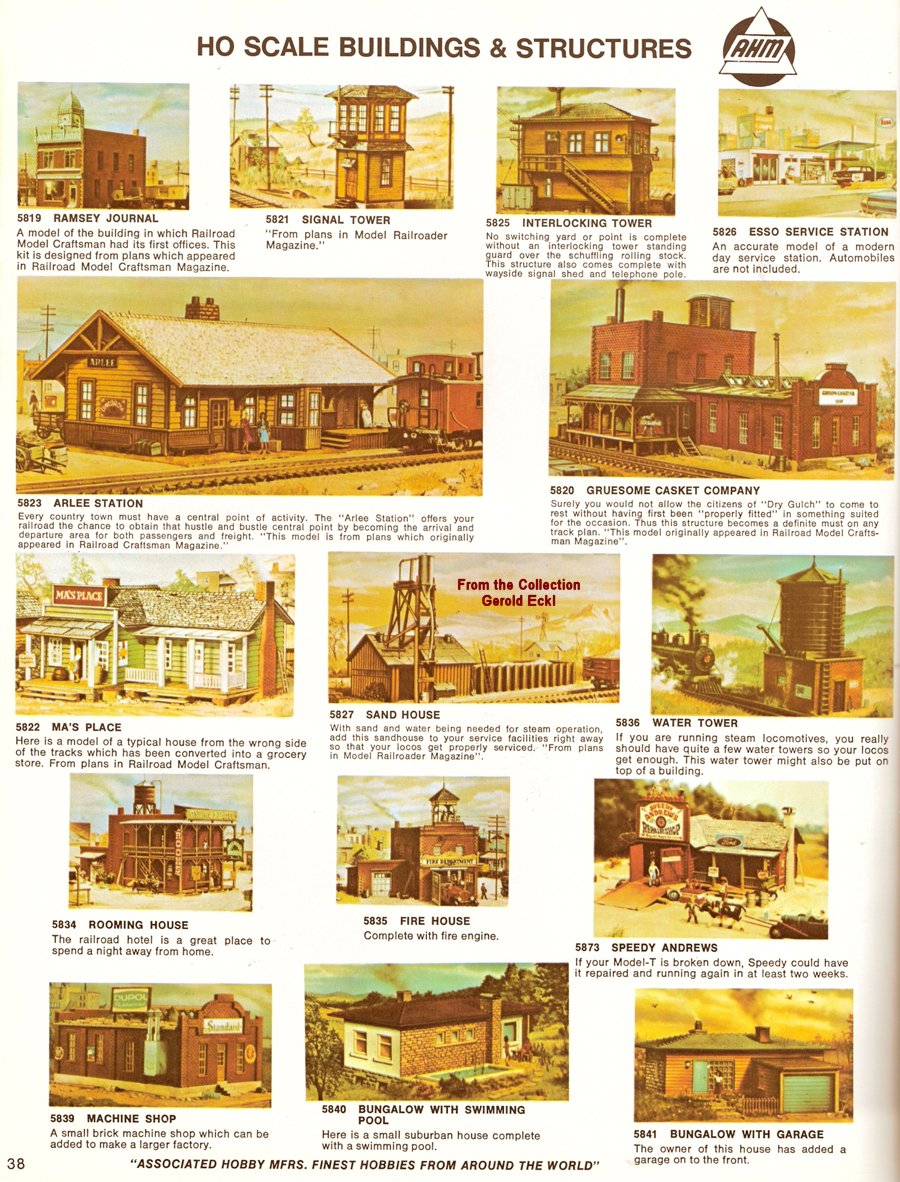
The Machine Shop is half of the Grusom Casket company kit - this little shop is one of the derivative kits, not one of the Original 9. On mine, the base's bottom is stamped with 'POLA-HO' and 'Made in Western Germany'. It looks like this kit had a long history as it was distributed by AHM, Atlas, and Tyco as well as Pola*.
  

I bought this fully constructed model many years ago at a local swap meet. It wasn't in bad condition, and only cost a toonie. I've learned the hard way to be selective about buying old kits that others have already put together. Some are horrible glue-bombs that can't be disassembled for restoration. Those I take a pass on. Others that have only been lightly stuck together with tube glues are better candidates. If they appear more-or-less complete, and aren't expensive, then I'll buy. It's those that I'm likely to have a better chance of successfully restoring, but there are no guarantees. It's only once I have had a chance to clean and examine the model closely, and try some disassembly, that I get a better sense if it can be easily restored. Luckily, my Machine Shop was in good condition; it was just a little ratty looking.


After thinking about this model for awhile I thought it might fit in rather well in the older part of the Ocean Park Loop along Mortimer Street. But, it needed a little modernization because Mortimer Street isn't a slum in the making, but simply a living street where the buildings are a bit older. And of course, since this a Moore design, so there had to be some Moore in the presentation :-)
---
We got off the car at the Mortimer loop around 4. The machine shop was a short walk away, on the other side of Ocean boulevard. Things were changing in the city, but this part still had lots of traditional buildings, new ones as well as old. Down here, people could still escape.

Cal brought his camera so we'd have a record about whether we'd have to do any reno work. It turns out the shop wasn't in bad shape, and maybe needed only a little sprucing up. A general cleanup, corner squaring, replacing missing roof stacks, window cleaning, and some work to make the facade a little more attractive to the customers and I'd be in business in no time.

Cal took some pictures. I did some haggling. 
---
The first thing was to cut off the old base because this building isn't standing out in some deserted lot with junk strewn all over the place; it's facing a busy street. It might have been a machine shop, or maybe a small appliance repair shop, in an earlier era, but today it has to deal with customers who don't want to be scared away by neglected surroundings and a dreary facade, so some general city-fication was called for.

To remove the base, I cut the corners off with a cutting disk in the Dremel, and then used the cutting disk to slice into the exposed foundation corners as close as I could get to the brick walls without touching them. This weakened the base and allowed for some careful flexing to get it unstuck from the wall bottom. You can see that little glue was used to attach the walls, so that was good. But, you can also see I tore the wall and foundation over in the lower right corner. The tear was small, and since that part was going to be hidden with a planter, I didn't spend time to fix it.


I think the biggest job on this project was adding the new foundation.

The base is a piece of 0.080" styrene cut to the edge of the main perimeter. The foundation pieces on which the pilasters - is that what they're called ? - rest are little pieces of 0.080" that were glued on later, and then ground with the Dremel and files to be flush with the pilaster surfaces.

The planters and entry were built up from styrene pieces and putty.


While working on the base, all the clear plastic pieces that had been glued in as window panes were pried off as they were scratched and dirty. I figured I'd break the window frames if I tried prying them, so they remained. The frames were given a loose wash of flat grey to tone down their plasticky brightness. 

The windows were replaced near the end of project with some 0.010" clear styrene.


The roof had a couple of issues that needed fixing. First, the piece itself had a dozen or so ejector pin marks that had to be ground out and smoothed. Then the missing ventilation stacks were replaced with items from Walther's roof top details kit. I used whatever seemed to look interesting and fit the roof.

After that little bit of reno work, it was on to painting. The shingles were hit with several washes of black, grey, and smoke. Once all basic painting was done, thin grey and smoke washes were sloshed on the entire roof structure to weather it a bit and even out the tones.

I didn't glue the roof in place so that lights could be added later.


Building up the facade was the fun part of this project.

First, as you can see, all that was done on the brick was to float on some, loose, thin grey washes. You could do more detailed brick treatments to the walls, but I just wanted to keep things simple.

The sign is just a balsa sheet with old-school Letraset lettering. I wanted it to look fairly new in keeping with the just-opened-for-business vibe. A street number, porch light, and entryway roof helped with the city-fication. A Moore Green door helped reinforce who designed this little building :-)
---
The new place has got a fancy coffee station, and Cal dropped by to help me christen it. I fiddled with the coffee machine while he settled back in a chair with his newspaper and read the classifieds.

"It says here some guy's got a box of oom-pah** records for sale."

I stopped making coffee and looked over Cal's shoulder at the ad. "Not a bad price. Can you circle that one? I'll give him a call later."

"You got a record player here?"

Darn, I knew I forgot something.
---

* E. L. Moore's Machine Shop has been sold in a number of different boxes over the years, without buyers knowing Mr. Moore was the designer. Here are a few box-top scans pulled from the internet and my stash.


This is the Grusom Casket company from which the Machine Shop was extracted for its own kit.


And there it is, AHM kit #5839.


At sometime later AHM re-issued the kit in a 'Masterpiece Series' box. The box-top painting has been replaced by a build-up of the model.


At some point in the '70s, Tyco got the molds and sold the kit in their brown-box line.


Things take a turn once Pola started to sell the kit. In this incarnation it's no longer a machine shop, but has become a pickle factory.

It doesn't have anything unique that visually indicates the new business, although, I do like how they've changed the foundation and base to make it more practical. There's also a loading dock and sliding door on the side.


At some point Pola put it in a box that actually said Pickle Factory.


Maybe the Pickle Factory label was simply for the English-speaking markets as this one, which obviously is targeted for the German market, refers to the building as Hengst & Co. Cannery. Maybe cannery and pickle factory are the same in German - I've relied on Google Translate for translation services :-)


The Hengst & Co. Cannery gets a nice blue box.


[Added 31 Jan 2020] It looks like Atlas also marketed the machine shop under the name Johnsons Inc. Chemical Products. The base and loading areas are similar to the Pola releases, and it looks like a water tower has been added to the roof.


[Added 18 February 2020] It's good to see that Walthers now markets the Machine Shop. The box has a rather clinical look compared to its ancestors, but at least it's still on the market.
[Added 12 May 2020] A version marketed by the West German company VAU-PE. What makes it unique are the extensive grounds and out buildings that have been added.


[Added 16 May 2020] Another blue box Pola variation, but this time some sort of benzene processing plant instead of pickles.

[Added 19 May 2020] Another Atlas boxing. Unlike Johnsons Chemicals this one is in red brick, points towards the right, and doesn't have a water tower. Overall it seems quite standard; it just has a different sign.


[Added 26 May 2020] A boxing in the Quick series of Pola kits. From the box-top painting this appears to be a box-stock branding without any additions to make it unique.


[Added 26 May 2020] Not to be left out of the action, our old friend IHC sold a boxing, and much like the Pola Quick version, this doesn't appear to have any unique additions.


I don't know if this is a complete list of all the Machine Shop's boxes and versions. If you're aware of others, please leave a comment.

** Back in the Jones Chemical Co. article in the March '74 issue of Model Railroader, part of the deal Eddie Jones makes with E. L. Moore to build the model was to hand over an oom-pah band record as partial payment - apparently handing over that item caused Mr. Jones some pain :-)


I don't know about oom-pah bands, but when I heard a Townes Van Zandt song called Blue Ridge Mtns. (Smoky Version) on his album Sky Blue that was released earlier this year, I immediately thought it seemed like something that fit in the E. L. Moore canon. You can find the song on the internet, but its embedding is disabled, so I can't include it here. The album has a haunting quality that stopped me in my tracks. Get it if you can. 

And yes, look up in the sky on the Sky Blue cover and you'll see a web of streetcar overhead power lines. Where was the cover shot back in '73? I need to find out.

Sunday, October 13, 2019

From the Time Machine's Glovebox: In Praise of Cheap & Cheerful Kits

This post got its start in the same way a lot of others have: an interesting discussion with Vince.

Well, ok, there was also another reason. The Art Curren post got me thinking that cheap and cheerful kits once had a place in the hobby. Some people bought the kits, built them as intended with varying degrees of skill, and put them on their layouts, but others, like Mr. Curren, used them as convenience items for kitbashing structures that were more to their own liking. And his preference, if his "Stratchbuilding"-with plastic kit walls in the June 1977 issue of Railroad Model Craftsman is anything to go by, was for the readily available E. L. Moore plastic kits that had been on the market for a number of years by that time.


At this blog I've built a few of those E. L. Moore kits, but more from the straight out-of-the-box perspective, than with a kitbashing intent. They aren't the most high fidelity kits, but with a little work, they can be rather attractive.

My first builds here at 30 Squares - Ma's Place and Speedy Andrew's - were the subject of this 3 part series: Part 1, Part 2, and Part 3.


What got Vince and me talking was that as well as the kits directly made from Mr. Moore's RMC articles, there's a whole other set of cousin kits that were manufactured based on the parts from the original 9 (there's a list of The Original 9 over at my Wikipedia article). Speedy Andrew's over there - really, an auto repair garage, not a surf shop - is one. You can see it's based on Ma's Place. I think it would be quite a lengthy investigation to track down the entire lineage of kits as the molds have changed owners, and the kits have gone in and out of production over the years.


It turns out, unbeknownst to me at the time, I did buy and build a couple of E. L. Moore kits back in the '70s. Ok, I knew I bought the kits, but I didn't know who designed them :-) That one is the Ramsey Journal Building that I tried to convert to a Home Hardware. A lot of the parts are now missing, but it was a semi-sensible conversion, although very basic on execution.


A couple of years back I bought this kit at a swap meet with an eye towards getting the parts I needed to restore my Home Hardware. I think I paid a loonie for it.

You can see the indications on the AHM kit that this was designed by E. L. Moore are long gone on this Tyco version.


Good thing I didn't pay too much, because it looks like the original owner took Art Curren's advice to heart and used the walls to build something else. Luckily, the walls are what I have, and it's the other parts I need.


Also back in the '70s I built E. L. Moore's Village Smithy kit. And, again, back then I didn't know about the E. L. Moore connection. I think somewhere along the line I cannibalized the kit to make something else, hence the missing parts. 


I have bought a few more E. L. Moore kits in this century. Over there is the W. E. Snatchem Funeral Parlor which interestingly enough, the manufacturer left the W off the sign, so no one will get the joke if they're not in-the-know - like you are :-)


I was so happy when I found an intact kit of the Molasses Mine. It was the subject of a build post and I was also lucky to see the original.


But, the rest of the kits I've bought over the last few years are still in boxes. That one is the sister project to W. E. Snatchem:  The Grusom Casket Co. That one apparently was for the German market because those red boxes announcing the kit was designed by E. L. Moore are in German.


I bought that AHM version of Grusom's because this Pola version I bought about 6 months earlier didn't have all the walls - half were missing. I didn't check the kit when I bought it, so my fault. Once again, someone was using the kit's parts to make something else a la the Art Curren philosophy :-)


I was more cautious when I bought this Busy Bee Department Store kit and opened it soon after it arrived. I was lucky to see the original this kit was based on back in 2015.

Just to prove that I opened it, I did an unboxing video.


Finally, I have this kit of E. L. Moore's Schaefer Brewery - retitled by Model Power - awaiting my acquisition of a second so I can build Art Curren's Perry Shibbel Fruit & Produce Co-Op that you can find in his 1988 book, Kitbashing HO Model Railroad Structures. I've studied the plans a bit, and it turns out I think Shibbel's could be built from a single kit with a strategic substitution of styrene brick sheets here-and-there.

Even from this small selection of E. L. Moore designed kits, you can see the masters have been owned by a few companies over the years, so compiling a list of them all, and their derivatives, would be challenging.