Showing posts with label Machine Shop. Show all posts

Tuesday, September 24, 2024

A Belgian-French E. L. Moore Machine Shop

On the left is the classic E. L. Moore designed Machine Shop kit reboxing by Pola.

It never ceases to amaze me where E. L. Moore influences show up. I stumbled across that photograph in issue #729, April 2008, of the French model railroading magazine Loco Revue in an article about modelling brickwork called Une brique dans le ventre (JDL: My rough translation: A brick in the stomach (! ?)) by Jacques Le Plat.

The caption translates to something like:

"The representation of plaster can transform the appearance of a common model, such as this Pola 814 workshop, full of charm despite its approximate masonry (transformation described in Good Kisses by Ferbach). The company name temporarily illustrated here was taken from the Yellow Pages directory."

Pola 814 is the Pola reboxing of the Machine Shop kit (a picture of which can be found here). I have no idea what "Good Kisses by Ferbach" refers to although I'll try and figure it out, and maybe revisit my 'translation' :-)

It seems E. L. Moore influences live on throughout the world.

Saturday, November 11, 2023

Edward C. Steinberg, Kitbasher Extraordinaire and Legendary Model Railroader

Steinberg has 3 articles inside, but no mention on the cover 

I began reading through the model railroading magazines of 1977 with one from January 1978. The January 1978 issue of Model Railroader to be specific. Long ago, and long forgotten, I had stuck a Post-It note to the top of page 58 to remind me where E. L. Moore’s Village Store article was, so when I was getting started on this reading adventure the doofus in me went straight for the little yellow flag sticking up amongst the field of pages on the shelf to see what I had marked, thinking that was the start to 1977. I wandered through the rest of the issue after saying hello to that old E. L. Moore article and was surprised to stumble across 3 different construction articles by the same author, an author who wasn’t E. L. Moore. It’s rather unusual to see 2 construction articles attributed to the same writer in an issue, 3 is rare indeed. The author was Edward C. Steinberg and all 3 articles dealt with kitbashing. I tend to think of Art Curren as MR’s kitbashing guy, and the leading light in kitbashing in general during that era, but I got a bit of an education when I went to look for more articles by Mr. Steinberg*.

I went to the MR archive, as well as the annual indices for Railroad Model Craftsman and Railroad Modeler, to see what he had published in the way of kitbashing and scratchbuilding articles in the 1970s and throughout the 20th century**. Here’s what I found (I’ve noted in () after the title what sort of article it is): 

1975

April: (MR) So you need a heavy-duty depressed-center flatcar! (kitbash)

May: (RM) The Great Coal Elevator (scratchbuild)

November: (RM) Quick & Easy Flat Cars (kitbash)

1976

January: (MR) Scratchbuild a loading platform (scratchbuild)

May: (MR) Stretching gondolas: 50’ + 50’ = 65’ (kitbash)

October: (MR) Bash a convertible bulkhead flatcar (kitbash)

December: (MR) A growing family of boxcars (kitbash)

1977

January: (MR) Model a contemporary lumber rack (scratchbuild)

February: (RM) Freelance Railcrane (kitbash)

    (NMRA Bulletin) Covering Stretched Mill Gondolas (kitbash)

March: (MR) Heavy-duty flatcar (kitbash)

    (MR) Levine Brothers Iron Works (scratchbuild)

May: (RM) Giant Hoppers for Coal (kitbash)

July: (MR) A large industry for a small layout (kitbash)

    (RM) The Super Tanker (kitbash)

December: (MR) Scratchbuilding a turntable (scratchbuild)

1978

January: (MR) The Eastwyck & Fensterstock Construction Co. (kitbash)

    (MR) Bash a transfer caboose (kitbash)

    (MR) Compound kitbashing to produce a feed mill*** (kitbash)

February: (MR) The big truck bash (kitbash)

    (RM) Dynamometer Car (kitbash)

March: (MR) Scratchbuild a depressed center flatcar (scratchbuilding)

April: (RM) Build a Bunch of Bathtub Gondolas (kitbash)

October: (MR) A diesel-powered rotary snowplow (kitbash)

    (RMC) Kitbashing a well-hole flat car (kitbash)

    (RM) Wartsboro Coal Elevator (scratchbuild)

November: (RM) Build a Railroad Magazine File

December: (MR) Modeling a bulk oil distribution terminal (kitbash)

1979

February: (MR) FA’s, Sharks, and Kadee couplers

March: (MR) Modern chemical tank cars (kitbash)

June: (RMC) 3 into 1: A Large Industry from a Smaller Trio (kitbash)

August: (RMC) Portable coal crusher

September: (MR) Toy parts into flatcar loads in one easy lesson

October: (MR) Mahjek Furniture Company (kitbash)

    (MR) Building a modern 60-foot automobile parts boxcar (kitbash)

December: (MR) Building a waffle-side automobile parts boxcar (kitbash)

1980

January: (MR) Safety-cage ladders

February: (RMC) “Standard Freighthouses (kit bash)

March: (MR) Build a wreck train (kitbash)

    (MR) A photo in the sporadic It Ain’t Prototype feature

August: (MR) The Greycourt interchange yard

    (RMC) Trackplan for the DLE&W

December: (MR) Building the Green River RR.: 1

    (RMC) An industry with heritage (kitbash)

1981

January: (MR) Building the Green River RR.: 2

March: (MR) Building the Green River RR.: Conclusion

    (RMC) Multi-level benchwork for the DLE&W

July: (RMC) Americanizing Wiking Trucks (kitbash)

October: (MR) Build a concrete plant (scratchbuild)

1983

January: (RMC) N&W-style caboose (kitbash)

1987

December: (RMC) RMC’s annual index says there was a Steinberg article published this month, but I couldn’t find it.

1994

August: (MR) Modeling Maxon Mills (scratchbuild)

2000

July: (MR) The shops at Marian Eddy**** (kitbash)

Although the article list is probably not a complete record of what Mr. Steinberg published it does strengthen the argument that he was a leading light regarding scratchbuilding and kitbashing from a period extending from the mid 1970s to the early 1980s, not to mention a major writer in model railroading. It looks like Mr. Steinberg’s heyday was in the late 70s, with 1978 being his peak year. Here’s a count of how many articles he published by year:

1975: 3

1976: 4

1977: 9

1978: 12

1979: 8

1980: 8

1981: 5

1982 to the end of the 20th century: 4

As you can see, his articles kind of petered out in the early 1980s.

Steinberg’s kitbashing articles are rather different in approach than Curren’s in a couple of ways. First, Steinberg’s appear to use prototypes for inspiration and design, and Curren’s kitbashes seem to focus more on what interesting assemblages can be made with available kits. I wouldn’t say one way is better than the other, just that they’re examples of two ways to kitbash.*****  Secondly, Steinberg did a lot of freight car kitbashes, again focused on replicating, or at least being inspired by, prototypes, and Curren’s work focused on structures.

MR carried a brief biographical note in their Dec. ’76 issue about Edward Steinberg. In it Mr Steinberg is quoted as saying, “I am more concerned with plausibility than with authenticity or correct prototype. I try to do what seems reasonable for my railroad, whether or not it may be ‘correct’. The purpose of the whole thing is to please myself. Ultimately, I suppose, I want to produce an operating miniature railroad. More than half the fun, however, is getting there.” This philosophy apparently didn’t go down well with some readers at the time. One correspondent in MR’s Aug ’77 issue complained that, “Kitbashed freight cars by Mr. Steinberg: These articles are reminiscent of the stage of development that model locomotive construction articles were back in the 1940’s. There is just talk of a prototype, but no photo of the prototype for those who want to decide for themselves whether the model has a close enough appearance to the prototype to suit their taste.” Another correspondent, from Sweden, in that same issue seemed to concur, “And Mr. Steinberg’s kitbashing techniques are good, showing how simple it can be to create variety in a freight car fleet. But without better prototype information included, freight car modeling will remain in a stone-age stage lacking all its potential appeal.” If you look at Mr. Steinberg’s complete works - with the benefit of 20/20 hindsight from this point in the 21st century :-) - many of his freight car articles do contain prototype photos, so you can judge for yourself. 

Maybe those comments were simply a sign-of-the-times. That was the era when the movement in model railroading to model prototypes as closely as possible was emerging, and 1977 saw the release of the first issue of Prototype Modeler magazine to cater to that market. I guess I’m more sympathetic to kitbashing whose concerns are with plausibility than high fidelity to prototypes as I came to model railroading from model car building where building plausible custom vehicles, and sometimes very wild ones, wasn’t unusual. 

Portrait snippets sourced from MR | MR | Obiturary
MR’s biographical note also mentions he was 34 at the time, and worked as a city planner. Mr. Steinberg died in 2018 and his obituary gives a little insight into his professional life. It’s noted that, “Ed earned a B.A. from Columbia College and an M.S. in Urban Planning from the School of Architecture & Planning at Columbia University. He began his professional career in 1966 as a planned [JDL: I think they mean ‘planner’] for the N.Y. office of the U.S. Dept. of Housing and Urban Development. He came to White Plains [JDL: in New York state] in 1970 to work for the Urban Renewal Agency, where he was later named Director. In 1985, he was appointed Commissioner of Planning for the city.” This may explain the drop off in articles in the early 1980s. He was moving up in his professional career at that time. His background in urban planning may also account for his interest in a more nuanced approach to kitbashing and scratchbuilding as opposed to a literalist one.

Before I leave you I should mention one more 1977 kitbashing story I found while researching this post. There’s an article by George P. Landow called The P. J. Macktez Woolen Mill in the May 1977 issue of MR. It uses the plastic kits of E. L. Moore’s Machine Shop and Gruesome Casket Co.. Well, so what you say? They were used all the time back then. Well, it’s the number of Machine Shops that’re used: 14 (!) by my count (and 1 Gruesome Casket). The article is cagey and never states how many Machine Shops you’ll need to build this large structure - maybe the editors thought by doing so they’d scare off readers. This must be one of the purest expressions you’ll find of Art Curren’s philosophy of using plastic kits as sources of walls, but to build it today with Machine Shops could be a pricey proposition. I was able to find Machine Shop kits in the Walthers Trainline series for sale at a Quebec based online retailer for $24.95 CDN each. Those 14 kits would cost a total of $349.30 CDN. An online inflation calculator tells me those same kits would have cost $75.77 CDN in 1977. Throw in a Gruesome Casket kit, plus some odds and ends to complete the project, and that would have been around a $100 CDN project in 1977. Too much for me then, and still too much for me now. The more things change, the more things stay the same :-)

--------------------------------------------------------------------------------------------------------------

Digressions

*I’ll probably have to revise my Secret History of Kitbashing given what I’ve recently learned :-)

**Trains.com used to have an extensive, searchable online index of model railroading magazines and their contents. It’s been gone for a year or two. I used to use it for all my searches as it was an excellent resource: professionally indexed and comprehensive. The NMRA has an online index, but, although it’s better than nothing, it’s a poor substitute. It’s far from complete, and the indexing and presentation of results needs serious revision. The majority of magazine articles I’ve listed in this post came from me slogging through the indexes for MR, RMC, and RM. I suspect I’ve missed a few articles and I apologize for that. And I wouldn’t be surprised if he published in places other than those 3 magazines. I don’t have a magazine collection that covers all publications, or an index that does :-( , so I admit my list is likely incomplete. Please let me know about any additions.

Later in the development of this post I came across a new index, RMI, which seems to fill the gap that Trains.com left. I’ve been giving it a try with searches for the articles of Edward Steinberg, but, although it’s promising, it appears to need work. However, I’m glad to see this development and wish them well.

***This is a particularly interesting article as it promotes kitbashing with craftsman kits instead of the usual plastic ones. 

****Another interesting project as it makes use of Walthers HO scale back shop. You may recall I did a conversion of Walthers N scale back shop to HO.

*****A third approach would be that of Kim Adams, who goes further than Curren does when it comes to imaginative approaches to kitbashing. 

Monday, December 14, 2020

Full size Machine Shop?

The Machine Shop-esque building on Bronson near Gladstone (Google Street Views)

We dropped by the Red Apron last week, and on our way there it finally dawned on me why the Cycle Salvation building seemed so familiar: it looks sort of like the Machine Shop and is about the same size. No, it doesn't have side walls of staggered windows, but it does have a rather nice side corner window that I need to take photos of. So, the Machine Shop, either box-stock or slightly kitbashed, could find a use on a streetcar layout with that bus stop replaced by a suitable car stop.

Friday, December 11, 2020

A two storey Machine Shop

I've been reading my way through Railroad Modeler, and in the Feb '79 issue found this picture of a Machine Shop kitbash on the layout of the Sacramento Model Railroad Club. It's a creamery that's 1 storey shorter than this one, but it's impressive nevertheless. The Machine Shop got around back in the '70s.

Sunday, November 15, 2020

Five Machine Shops maketh a three-storey factory

Snipped from a larger image in RMC Jul '89

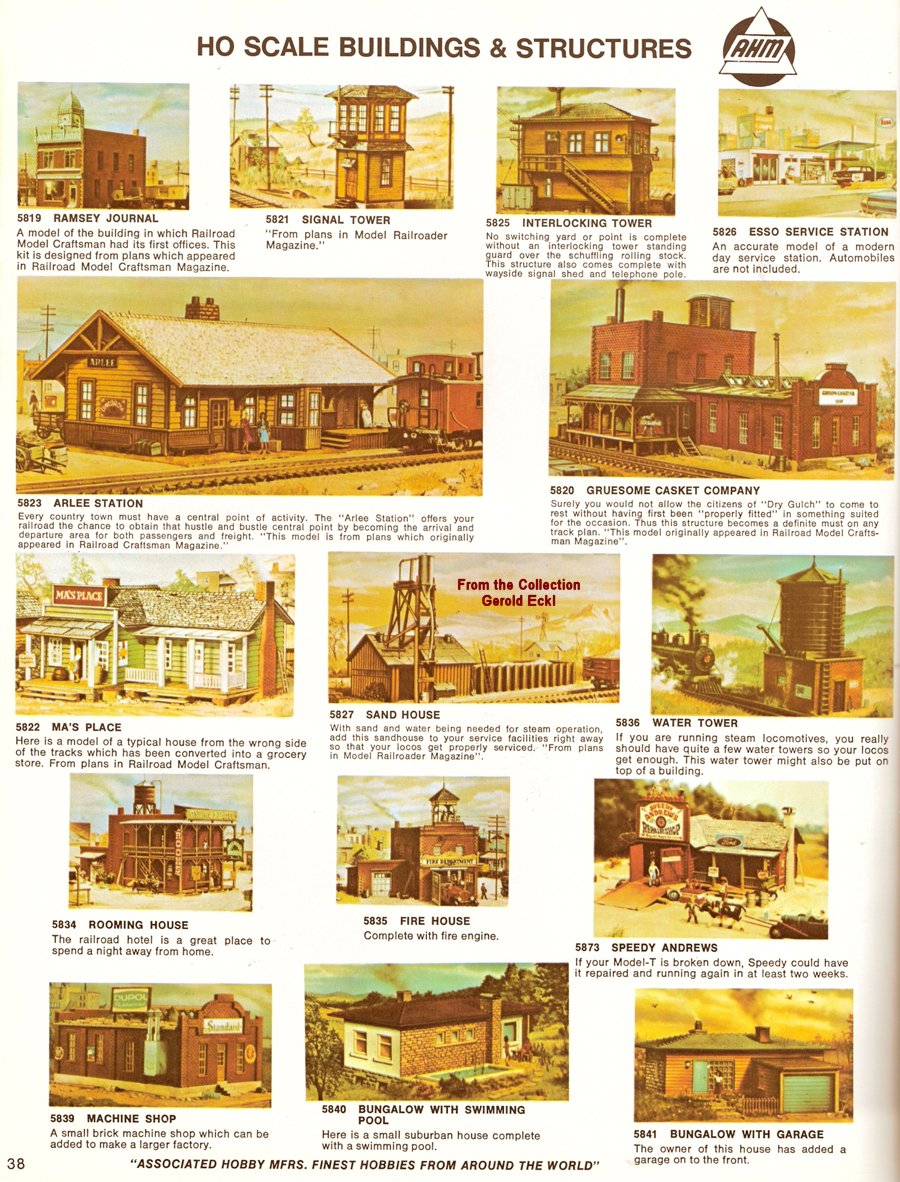
The July 1989 RMC / Dremel Kitbashing Award was won by Thomas W. Rimer for his Kitbashing a multi-story factory project, which made use of 5 Machine Shop kits to build a 3 storey factory. 

One thing you'll notice about this building is that the tell-tale 2-up, 2-down jog in the sidewall window arrangement is absent. Galen noted that it's that arrangement that makes the Machine Shop noticeable in a scene, and he's right. I have to admit that the only reason I didn't skip over this model was that the first sentence of the article called out the AHM Machine Shop. A skillful arrangement of wall panels has eliminated the jog.

It looks like the long Machine Shop only used 4 kits, so this factory with its 5 appears to be the current winner in the most kits used category.

And one more thing, this kitbash also makes use of balsa, so there's Moorian DNA all throughout this model :-)


Thursday, November 12, 2020

Grusom Casket becomes a country store

Snipped from a larger image in June '87 RMC

The winner of the June '87 RMC / Dremel Kitbashing Award was Richard Bower for his kitbash of E. L. Moore's Grusom Casket kit into a country store. Well, it's more of a country store complex made up of a store from the 2-storey part of Grusom's (aka, the Ramsey Journal part of the kit), and a gas station and garage made from the 1-storey part (aka, the Machine Shop). It's a handsome and ingenious bash that turns a single Grusom Casket kit into something completely different. 

Tuesday, November 10, 2020

E. L. Moore's Machine Shop on The Franklin & South Manchester

Snipped from a much larger photo in the Nov '86 issue of RMC.

There's an excellent photo essay by Steve Sint in the Nov '86 issue of Railroad Model Craftsman on George Sellios' famous Franklin & South Manchester Railroad. Buried off to the corner in one of the photos on page 71 is our old friend the E. L. Moore designed Machine Shop squeezed between two taller buildings. The roof is a little different, but the walls make it clear what building this is. This little building seems to be popping up on some of the largest layouts. Hopefully there're still surprises ahead.

Monday, November 9, 2020

A very long E. L. Moore Machine Shop

Snipped from Massive HO layout with almost a mile of track.

I was watching Toy Man Television's episode on Verryl Fosnight's HO scale layout of the Wyoming Division of the Union Pacific and at around the 4:10 mark I saw this kitbash of the Machine Shop. It's the most extreme bash of the kit I've seen so far, but look at the layout it's on, it's amazing.

I'm a big fan of Toy Man Television and its relaxed vibe: highly recommended.

Thursday, July 9, 2020

Grusom Labs

Scanned parts from AHM's Grusom Casket kit 
Now a railroad terminal building with tracks underneath and offices above, if I can latch onto a starting idea, I might develop something along that line.
E. L. Moore in a letter to Hal Carstens, dated April 2, 1969.


I lead with that quote in a post called What would E. L. Moore do ? back in July 2017. Here we are 3 years later, and I still can't say what E. L. Moore would do, but maybe Art Curren might do a kitbash of this brief based on Bell Labs' Manhattan building using the parts from AHM's Grusom Casket and Machine Shop kits. My simple parts layout certainly needs some size adjustments so that trains or streetcars could pass through the tall centre structure without incident, but those components from Grusom Casket might just do the trick for this project. However, the cost of all those kits would be crazy expensive!

Monday, June 29, 2020

Another from Germany

Image snipped from box of Vollmer 45612
This is another kit Martin found that has similarities to the Machine Shop. It's Vollmer kit # 45612, called the Workshop.

Frankly, its look doesn't say Workshop to me. It says things like bank, library, accountancy, or post office. Removing the peaked ends to convert it to a flat roofed building, and getting rid of the roof-top stuff as well as the decorative insignias, it could reside on the OPL. 

These Machine Shop like buildings are no doubt a common building type in the world of HO architecture.

Saturday, June 27, 2020

A relation in Germany?

Old Machine Factory by Auhagen
While Martin was searching for Grusom Casket kits he came across this beautiful model by the German company Auhagen. I must admit the overall form and arrangement are indeed reminiscent of the AHM / Pola Grusom Casket kit as Martin pointed out to meNot to mention that the kit's name has 'machine factory' in it, and a spin-off from Grusom Casket was a 'machine shop'. And, Grusom Casket was originally manufactured by Pola of West Germany. Was Grusom Casket chosen to be manufactured by Pola because it had some similarity to a German building type that suggested the kit could be successfully marketed in Germany and elsewhere in Europe as well as the US? Interesting speculations aside, I can't draw a direct connection with Grusom Casket. But, as I've said before, the similarities are similar :-)


Repair Shop by Auhagen
Well, there's one other thing. Auhagen is also marketing the one storey part as a separate kit - the Repair Shop in the photo on the right - which is what AHM did with the 'machine shop' end of Grusom Casket. As well as the Repair Shop there is also a red brick variation in their Gas station with a car workshop kit.

Much thanks to Martin's eagle eyes for finding these kits! I continue to be amazed by what's out there.

Friday, June 26, 2020

All the news that's fit to mold

While we've been on this Machine Shop journey, there've been some related sightings along the way.

Martin found this Globe News kit from Model Power. It seems to bear a passing resemblance to the Machine Shop


But, as you can see when you lay the walls out for comparison, Globe News is much larger than the Machine Shop.

Like the Machine Shop, Globe News has seen several boxings, and the one in the comparison photo is one of the many - I know it isn't the Model Power, and I need to note which one it is. However, for size comparison purposes, all Globe News kits are the same.


It was seeing the roof in the Globe News' box top photo that made me think of the Machine Shop, but without a size reference, I wouldn't have known that the Globe News' roof was much larger - the box top photo played on my desire to want to believe that the Machine Shop was the Globe News' mold ancestor. Scales and rulers can help straighten out the mind games of photos :-)

Jilted ancestry aside, I rather like the Globe News kit. Without the rather elaborate roof top decorations, it could pass on my layout. I might go so far as replacing the roof with a flat one. Actually, this might make for an interesting N-scale streetcar car barn.

Tuesday, June 23, 2020

A Machine Shop boxing found ....

... while I was cleaning out the Time Machine's trunk. I must have had the thing set to Alternative Universe when I picked this up.

Time travel is weird :-)

A side order of Machine Shops

If you've been following along with the Machine Shop boxing saga you know there were many variations. 

I find this view of Martin's collection of several of those boxings quite interesting. Over on the left are the original AHM and Pola boxings. On the far right is the last boxing, the one from Walthers. I'm not quite sure just yet what the order should be for the other boxings, but it's interesting that the kit box went from a lively little offering with a colourful painting on the lid to a much larger box in a bland, utilitarian style (the Walthers site says it's now out of stock and discontinued). In his Machine Shop journey Martin has found a number of other kits that bear some resemblance to the Machine Shop - although they don't appear to be derived from it - and I hope to post some pictures of them in the days ahead.

Sunday, June 14, 2020

Foundation and Machine Shop*

Snippet from a larger photo in E. L. Moore's  Grusom Casket Company, RMC, June '67
If you've been following along you know there're a lot of variations on the AHM Machine Shop kit out there. One of the significant differences between some of the variants is in the foundation and loading dock. Ok, so which one of the variants is the 'real' one?

It's the ones with the stairs outside the front door like those on the original AHM kit, not the ones with the concrete loading dock. Burn's Engineering is a good example of one that has a loading dock, but there are several that do as the kit list at the Moore's Balsa Products shows. Although, the ones with stairs outside the front door also have a junk strewn base, which as you can see in the picture from E. L. Moore's article is a fabrication - the area near the base on the original is junk free.

Since I'm doing a deep dive into authenticity minutiae, I'll point out a couple of other things. The back half of the original is clad in red brick and the front half in yellow - notice in the photo the darker back half. This is deliberate. The yellow brick part is meant to represent a new addition. So, if you're building a Grusom Casket Company kit, or maybe an 'authentic' Machine Shop, consider making the back half red brick and the front yellow. Also, take a look at that front door. It has a classic three-window design common on suburban houses of the '50s and '60s. The kit's door is somewhat more standard. Ok, now that we're nitpicking, the upper portion of the front facade is somewhat different from that of the kit, but that is almost impossible to fix without a complete overhaul, so I'll overlook that. And one more thing if those weren't enough: the skylights only extend over the red brick half and not over the newer yellow brick portion. Ok, I'm done. For now :-)
*Isaac Asimov's Foundation series is another we tried to read, but didn't even get through the first book. I bought Foundation in the '70s and the other three at a secondhand book store in the '90s (?) for 50 cents each. I had high hopes I'd try the series again. And, yes, I've tried the first volume twice again, and each time couldn't get through it - it seemed rather dull. Well, just as E. L. Moore was saving television for his old age, maybe that's what I'm saving the Foundation series for.

Tuesday, May 26, 2020

Recently Updated: Moore's Balsa Products & Machine Shop Kit List

News Flash! 

If you've been following along at home you may have noticed that I've been updating the list of boxings of the E. L. Moore designed Machine Shop kit in the Moore's Balsa Products post. Martin has generously shared images of a number of boxings he's found, and so far there are 14 (!) in the list (the AHM original, kit #5839 + 13 reboxings). Yes, 14. I have no idea if this many was common in the industry, but it seems like a lot to me. There might still be more out there. I'll keep you posted.

Tuesday, May 19, 2020

Johnsons Chemicals or Burns Engineering?

It's weird how my memory works. When Martin sent me a photo of this Burns Engineering Corp. boxing by Atlas of the machine shop, which they had also boxed as Johnsons Inc. Chemical Products, my mind flashed on seeing lots of machine shops with Burns signs back in the '70s, but for some reason this only bubbled up when I saw this box top. The painting on the Johnsons boxing suggests it's moulded in yellow brick, and has a water tank that this one doesn't. The variations and boxings this kit has seen never ceases to amaze me. I wonder if this is typical for these cheap-and-cheerful kits, or if this is unique to the machine shop? 

Monday, May 18, 2020

Machine Shop '73

Martin noted that the machine shop that appeared as a new product in Pola's '72 catalogue, appeared in AHM's '73 catalogue. You can see that AHM used the same painting Pola did. I wonder if there was a '72 AHM catalogue, or if their '73 catalog was published late in '72 - say, in time for Christmas - because I'd like to narrow down the date when the kit became available in North America. Well, on the other hand, given where we are in the 21st century, it hardly matters much if it was released 47 or 48 or even 47.5 years ago, the fact that it's had the life and longevity that it did is amazing in and of itself.

Sunday, May 17, 2020

New for '72

I've been browsing through these Pola catalogue scans and came across that image from their 1972 combined HO / N catalogue. Obviously from the 'neu' the machine shop was a new release for 1972. AHM was the North American distributor for the E. L. Moore kits so I need to find an equivalent entry in an AHM catalogue.

Saturday, May 16, 2020

From Machine Shop to Benzene Separation Plant

I think the 30Squares Media Empire is going to have to open an E. L. Moore research centre in England to supplement those in Virginia, Toronto, and Ottawa - not to mention all the great leads sent by readers worldwide - given all the excellent information Martin is sending me. This fascinating Pola 'Benzolabscheidung', which Google Translate tells me means 'Benzene Separation'*, that Martin found is clearly another variation on E. L. Moore's AHM Machine Shop kit. But, there's a little twist in this version: it looks like the back wall has been replaced with a front wall casting, and clearly the tar paper roof has been replaced with what looks like a tile job and a dangerously tilted chimney - well, I can't quite make out the roof covering, but it clearly isn't tar paper and skylights. I've said it before, and I'll say it again, it's amazing the number of E. L. Moore kit variations there are out there.

*Benzene separation? OMG I hope that isn't some kind of residence behind the plant, and is that yellow double-decker bus in the background dropping off people nearby? Benzene is nasty stuff. Years ago I worked in a lab doing research on ways to separate oil from tar sands, and benzene was one of the solvents tested. We had to wear all kinds of serious PPE and follow very strict lab protocols for handing the stuff. I gave up chemistry after that and tried to find a sedate desk job where paper cuts and eye strain would be my main worries. I would not want to see how benzene is being handled in a re-purposed machine shop :-)