Tuesday, April 10, 2018

33 to 41 for 2

Layout height is often a concern and although it’s not a big one, it has some implications. Over the past few weeks while working on the Alta Vista TC, I’ve come to appreciate its street-level height of 41 inches above the carpet as it’s very comfortable for me to work at while standing. I’m 5’-8”, so your dimensions may vary.
By contrast, the EVRR has always been on a Workmate during construction, and its 33 inch height I’m finding less than optimum. It’s awkward for sitting at as I always seem to be reaching across it to other places and bumping things. And it’s much too low for standing while working. I’m going to raise it to 41 inches or so, and place it directly under some room lights so illumination is improved. Perhaps that will speed up progress :-)
When it comes to showing off these layouts, and especially the Alta Vista TC, I want to boost them to close to eye-level. My rationale is this: when I’m riding the streetcars and buses and subways of Toronto, I’m experiencing everything at eye-level, not from some giant’s aerial perspective. Even at 41 inches, roofs dominate the view and I don’t want that. Also, with the Alta Vista TC’s bent island design, the higher street-level will allow viewers to walk-around, look around corners and down streets much like in they would in the world. All this might not apply to the EVRR – it might have it’s own unique height that gives best viewing. Some experimenting is probably called for.

Sunday, April 8, 2018

EVRR tunnel portal #2

Last night I spent a little time looking through E. L. Moore's EVRR photos for a good picture of the tunnel portal that appears on the level below the stone one. These 2 snippets are all I could find. It's some sort of wooden crib and box-like structure. Clearances are tight in that area of the layout, so some careful measuring will be called for before I start to build. Also, there's a switch just inside the portal, so that'll complicate things.

A tunnel portal by E. L. Moore

This photo was among those in the E. L. Moore collection. For the longest time I wasn't sure what it was, so I refrained from posting it. But, while looking for photos of EVRR tunnel portals last night, I stumbled across this image from a larger Enskale & Hoentee RR photo that helped me put 2 and 2 together.
While the two don't exactly match, it suggests the upper image is of a newly constructed tunnel portal. I don't know the scale as there was nothing in the photo to compare it to. Could be HO, could be N.

Thursday, April 5, 2018

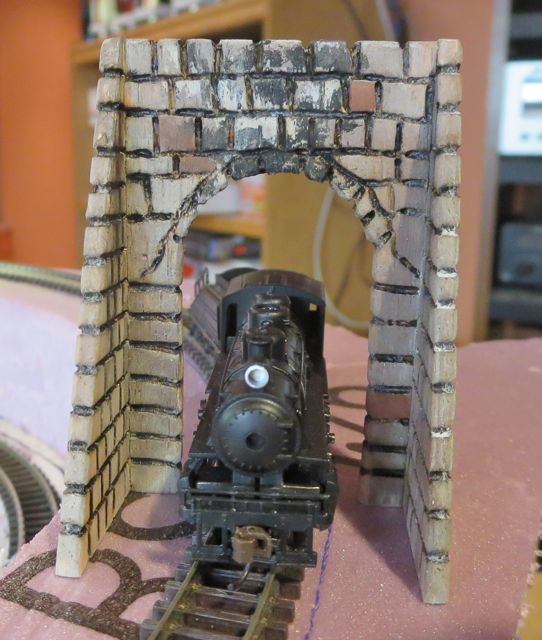
Partial portal progress

I used a sharp, new X-acto knife blade and some sanding sticks to stair-step the portal abutments, and when that was done, they were given thin washes of grey, white and Tamiya Smoke to naturalize and tone down their colours. They’re looking better, but they’ll likely need a little more blending and weathering once they’re installed.

And speaking of colours, I have no colour reference photos of the EVRR. No drugstore processed snapshots, no Kodachromes, no Ektachromes, no Fuji Chromes, no torn out photo-spreads from magazines, no nothin’. I don't even know if any exist, but be that as it may, this is a world-wide call: if you have any and could share, please leave a comment. There’s no money involved, but think of the glory :-) Maybe I should see if Vince has the time machine repaired. Until next time ….

Sunday, April 1, 2018

Try wood burning for tunnel portals!

E. L. Moore published 2 articles about using a woodburning pen as a modelling tool: Burn those models in the May '55 issue of Railroad Model Craftsman, and Modeling with a burning tool in the July '62 issue of Model Railroader. The second one includes a photo of an EVRR stone tunnel portal as an example. That being the case I figured I'd pull out my woodburning pen and try making some N-scale tunnel portals.
I haven't used the pen in quite awhile. I think the last time was on one of the very first projects in the E. L. Moore in the 21st Century series. 
I decided to practice by building the river and road portal that appears under the EVRR's Rocky Ridge. The portal was sketched on a piece of 1/8 inch thick balsa and the openings were cut out prior to burning.
After burning in the mortar lines this is what it looked like. You can see it's more of a caricature of a portal than a true scale representation. Likely I could do better with a more precise initial sketch and a finer pen point, but this a model railroad in the old folk-art-style of construction, so I think it'll fit in.
After a bit of dry-brush painting with greys and browns, voila!
Then there was a little test fitting over the Rocky Ridge inlet and once satisfied that it fit, it was on to the mountain portals.
I printed out the MR '62 article and found that when I placed my loco on the image it was about the same size as the loco in the photo. From that and studying other photos of those stone portals I came up with some dimensions.
Both portals were drawn side-by-side with the intent of slicing them apart after burning. The track clearance is on the tight side given the clearances on the layout. If the rolling stock were longer than the old-time pieces that this layout uses, the portals would not be wide enough to accommodate them.
I had started the mountain portals I had gotten the hang of using the burning pen and things went a little faster. Once again, this is a caricature of a portal and not a model. 
For all the portals I used the 'pen' tip in the burning tool as it seemed to have the finest point of the lot I had on hand. Its edge was used to burn in the block sides.
After burning, the pieces were cut out in preparation for gluing on the abutments, which were made with the techniques shown above. 
As I worked on this little project I started to think that the woodburning pen is close to being the ultimate tool for folk-style model building. 

Let me backup a bit. I think E. L. Moore was the last and the best of what might be called the folk-art-style model railroaders. That approach to model railroading leans heavily on non-specialized materials and tools that can be found around the house or easily obtained at nearby stores. It doesn't completely forsake specialized components produced by the model railroading industry, but it's not dependent on them. 

The woodburning pen allows you to create, as E. L. Moore put it in his Model Railroader article, shingle or shake roofs, clapboard siding, brickwork (foundations and chimneys), stonework (foundations, chimneys, portals, bridge sides), platform planking, board siding, plank floors; simulating cracks, knotholes; aging surfaces; making sheathing for coach, caboose or boxcar.* With that capability you don't need to buy a lot of things on offer in the magazine ads. That makes woodburning economical, and a bit subversive as you're saving money, which was important for Mr. Moore as he had modest means, and bypassing the messaging of the advertisements. These go against the prevailing culture.

I've often received feedback that finescale approaches, their materials, tools and practices, are the ones to be admired and pursued, and others, like those exemplified by E. L. Moore, are of little concern, and if continued, represent a regression and lack of understanding concerning what the hobby is about. Myself, I think there are different approaches or styles. Finescale and the desire for high fidelity is one approach - a very admirable one - but there are others. Frankly this idea of different styles didn't dawn on me until I was deep into the E. L. Moore story. I realized he was driven to express his thoughts and experiences of early 20th century life and railroading, but he was on the low end of society's slippery economic pole, so he got on with things with what he could readily access, but he didn't forsake making things as good and accurately as he possibly could - that wasn't abandoned or ignored. He was driven to express what he had to express for some reason known only to him. Would his work qualify as museum quality artifacts that could represent objective historical facts? No. Does that matter? 
[I've known for awhile that the back stretch will need to be widened with a piece of foam glued to the back edge. This proves it.]

Ok, I did take a stab at thinking about styles , although I didn't exactly think of them as styles, well before the E. L. Moore journey. Looking back, I don't completely agree with my original assessment in that post as the journey has taught me a lot. I didn't know folk-art-style existed and was a legitimate approach. I'm not happy with the term 'folk-art-style' because it conjures up images of basket weaving and hippies, but it's not far off from the stuff categorized in the mainstream art world's folk art category, so I'll hang on to it until something better comes along.

A question that I ask myself is if the so-called folk art style is actually a legitimate style, or just a historical phase that the hobby went through. It was the dominant style at one time because to proceed that was what one did, so it's historical origins can't be denied. Today we have options even though it doesn't seem that way from many of the companies or publications. I'm still pondering this one.

So, if one isn't predisposed to buying a lot of specialized model making materials, developing skills with the woodburning pen is a good thing. Although, I imagine woodburning techniques work best in HO and larger scales; but for caricatures, they're ok in N. 

---

* The brick walls of E. L. Moore's Firehouse model were made by scribing a brick pattern into sheets of balsa. Did he use a woodburning pen? Maybe, but I don't think so. Here's a detail shot of the brick pattern. It looks a little too clean for woodburning.