Wednesday, April 8, 2020

Skill

For of course I am completely an elitist, in the cultural but emphatically not the social sense. I prefer the good to the bad, the articulate to the mumbling, the aesthetically developed to the merely primitive, and full to partial consciousness. I love the spectacle of skill, whether it's an expert gardner at work, or a good carpenter chopping dovetails, or someone tying a Bimini hitch that won't slip. I don't think stupid or ill-read people are as good to be with as wise and fully literate ones. I would rather watch a great tennis player than a mediocre one, unless the latter is a friend or a relative. Consequently, most of the human race doesn't matter much to me, outside the normal and necessary frame of courtesy and the obligation to respect human rights. I see no reason to squirm around apologizing for this. I am, after all, a cultural critic, and my main job is to distinguish the good from the second-rate, pretentious, sentimental, and boring stuff that saturates culture today, more (perhaps) than it ever has. I hate populist kitsch, no matter how much of the demos love it. To me, it is a form of manufactured tyranny. Some Australians feel this is a confession of antidemocratic sin; but I am no democrat in the field of arts, the only area - other than sports - in which human inequality can be displayed and celebrated without doing social harm.
Robert Hughes in A Bloody Expat, from Things I Didn't Know: A Memoir. To the last sentence, as well as sports, I'd add mathematics and science. For bracing, direct, and thoughtful commentary I highly recommend anything by Robert Hughes, even though I might not always agree with him.

One aspect of the model railroading medium that spans all uses and interpretations is the high regard held for skill amongst its practitioners. So much so that the associated magazines and journals, whether mainstream or specialist, showcase skill - tailored to the degree their editors deem their target audiences can appreciate - that they have a strong bias towards how-to instructional stories, layout tours, and research, in addition to advertising. And skill usually means a focus on making things realistic, operable, and reliable.

The relationship with ready-to-run items and commercial products that make things 'easier' is fraught. Over the decades the concern with skills degrading as technology and commercial offerings improve, and often exceeding what amateur hobbyists can do, remains ever present, even though the actors change. Is it a sin to buy or build plastic items in comparison to wood, paper, or metal? DCC versus DC? Kits versus scratchbuilding? Laser cutting, 3D printing, sheet cutters: are they ending traditional construction methods? Once again, discussing these independently of people and how they make use of - or don't - what constitutes the medium leads one astray. The question should be, what are people doing with the medium?


There's also the related issue about how much ready-to-run is too much. I think the question of skill also underlies this concern. Whether a layout is built completely from items purchased at swap meets or the latest high tech vendors is almost irrelevant if the owner exhibits no skill in doing whatever it is they're doing with the stuff.

As I mentioned before I'm reading old books from my shelves while I'm holed up at home, and what got me thinking about skill was the following passage from Gary Garrels' Drawing From The Modern 1945-1975  about deskilling as a practice of 20th century artists, viewed in light of David Hockney's comments on skill I noted in an earlier post. It struck me as being completely at odds with an unspoken ethos of model railroading, and model making in general. Even though some form or another of model construction has existed for centuries, it only seems to have taken off in a mass sense in the 20th century, so with its emphasis on the skill of the maker, it stands in contrast with a 20th century trend of artists willfully deskilling. 

While processes of "deskilling" have a long history in modernist art, the term has been in use in an art context for only a relatively short period of time. In one of the first published instances, in 1981, artist and critic Ian Burn used the term to a very specific kind of practice in which an artist delegated control of the technical making of the object to "skilled" workers, such as the industrial fabrication of Minimalist sculpture. Recently, the term's usage has grown to include a broader range of artistic activity, including the more widespread strategies of artists willfully renouncing learned, or traditional, habits of making in works they produce themselves. Like drawing with the left hand if right-handed, deskilling is meant to inhibit both repetition and easy elegance, and reliance on practiced abilities. A method of intentionally setting roadblocks in the studio, deskilling is one of a number of classic modernist operations intended to circumvent the often overly determined ways in which art is made and received, as well as to critique the romantic idea of the all-knowing, all-controlling genius artist.

You're right, I need to give all this a lot more thought, especially with regard to how long established ways of using the medium are overcome or modified to produce truly new works. In the above you've got a willing deskilling of the creator to produce new insights, and with model making it's commonly thought that only through individual upskilling that new and interesting objects are possible.

Monday, April 6, 2020

Facade for the CP building

Over the last few days I've been working on the facade for the centre building in what is going to be a three building complex. 

Like always, I spent a long time pondering how I'd go about building up this piece. I try to figure out enough to get construction started and not get stuck in a paralysis-by-analysis state. 


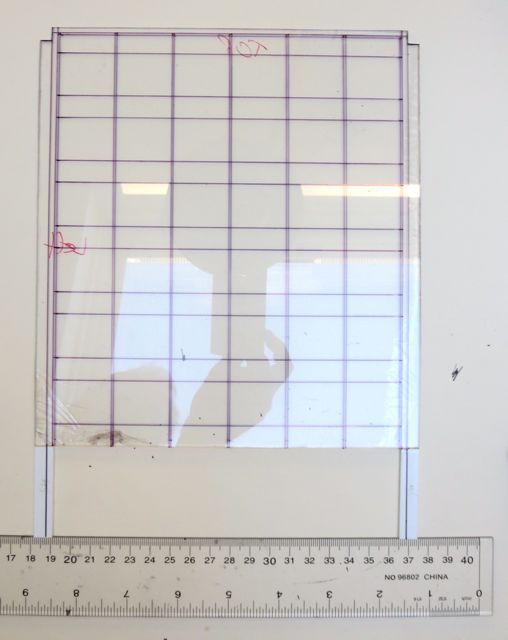
Once the dimensions had been determined a blank was cut from 1/8" clear acrylic sheet. Those legs on the bottom corners are pieces of 0.080" styrene bonded on with liquid glue. 

I figured out the dimensions for Thomson building, the Canadian Press complex, and the yet to be started Newhart Tower in February and cut all the blanks at that time. I did that for two reasons: I figured it was more efficient to cut them all at once when I had the workshop set up for that task, and I wanted to get the relative heights of all the key highrises clearly established so I had a sense of how the layout's vertical dimension would play out.


The next task was to draw all the major elements onto the blank with a fine black permanent Sharpie pen. Lots of arithmetic and head scratching went on until I had a good, consistent set of dimensions.


All of the coloured panels are cut from off-white and black construction paper. They are attached to the blank with 3M transfer tape. 

On the prototype the light coloured panels are closer to cream than off-white, but my choice was based on what I had on hand, and thought it was good to make them a little lighter so the contrast with the buildings on either end of the complex is stronger. Once they're weathered, they'll seem a little closer to the prototype.


The vertical and horizontal 'metal' pieces are made from 1 mm square styrene strips. 

Before installation they were painted with a Tamiya flat aluminum paint. Next time I'm going to try colouring these sorts of pieces with a silver Sharpie pen. I didn't have one around the house to give it a try.


The styrene strips were attached to the blank with Weld Bond glue. I cobbled together a little 'workstand' to keep glue application clean. A strip was placed on the masking tape loops and glue was applied with an old, fine brush.

After attaching the strip to the blank, a small wooden ruler was used as a guide to make sure the strip was straight and aligned to the guidelines. A sharpened toothpick was run along the edges of each glued down styrene strip to scrape off any glue that got squeezed out during attachment.

Lest you think all went smoothly, there was a minor disaster about halfway through the gluing process. Not shown in the photos is a small container of water I used periodically to clean glue from the brush. In a moment of thoughtlessness I knocked over the container and water splashed all over :-( Much cursing ensued. After cleaning up and taking a break I put a masking tape ring about the water container to help make it a little more resistant to tipping. No more spills on this project, but it emphasized to me the importance of making sure the work area is clean, and only the necessary tools and materials are present when working on some particular task.


The horizontal panels are all individually cut and installed. This is different than the technique I previously used. Up until this project I'd apply the horizontal panels in one continuous strip and then cut out pieces for installation of the verticals. On this project, since the vertical slots would only be 1 mm wide, I didn't think I could cut them accurately using the previous method, and since there is only one surface to cover I didn't think attaching individual pieces would be too tedious. It wasn't. I paced myself and listened to Radio Deluxe - it turned out to be a fairly pleasant task.


And once all the horizontal panels were attached, the horizontal 'metal' bars were added. Like the verticals, these too are 1 mm square styrene strips, and were glued on using the same method as the verticals.


And that's that. 

For the rightmost building in the complex I've ordered a City Classics kit that when modified will act as a reasonable stand-in for the prototype that's in that location. But, until it's delivered I think I'll move onto getting these facades attached to buildings.

A Shadow for our times?

Who knows what viruses lurk in the lungs of men? The Shadow knows.

I bought this Pyramid Books reprint of a story from the April / June 1931 issue of The Shadow Magazine back in the '70s. My father was a Shadow fan and passed along the interest. So, it seems I've always liked The Shadow, and somewhere in this place are some comics and another paperback in the Pyramid Books reprint series. With his signature face obscuring red scarf and rakish fedora, maybe we'll see a Shadow resurgence, what with mask wearing and all :-)

The cover painting says STERANKO in the lower right corner. I wonder if that is Jim Steranko?

Sunday, April 5, 2020

Body Installed

All the pieces in step 2 of the instructions were finished over the last couple of days, and that meant the body was ready to place on the chassis. The parts fit surprisingly well, and there's little flash to remove.

This tacky little project is proving to be a guilty pleasure :-)

Hollywood Squares north?

I love the facade of the Canadian Press building. All those windows. All those shades. All the light-dark patterns. And the potential for lots of scenes. 

It took me awhile to compress the facade and get it down to something reasonable. When I was done, I drew the pattern on a piece of clear acrylic with a fine-point Sharpie. The panels shouldn't be too difficult to install, but the relatively fine metal dividers that carve the facade into squares might be a little tricky.