 This lookout station is built primarily from the leftover cab from the AMT/Ertl 1/24 scale Li'll Gaser kit that was used to build Li'l Aqua and some Buddha figures bought at a nearby Japanese gifts store (although, figures of this sort can be bought at just about any Chinese variety and gift store).
 The Li'l Aqua project used the back end of the Li'l Gasser kit, and the front end got relegated to my spares box.
 The base was made from 0.080 inch sheet styrene, and everything - base, structure and Buddhas - was painted with PolyScale concrete coloured acrylic paint. Some loose washes of gray, black and rust coloured painted were then applied to add some visual interest.
 The skylight, circular basement viewing port, and balcony are castings from the Tichy Train Group. I bought an assortment box of HO building details from Tichy last year, and it has come in handy in supplying parts for a variety of projects. The inside and outside ladders are items from Plastistruct.
 The couch is built-up from styrene scraps and is meant to be in a modern, mid-century, 1950s-esque style. The abstract art on the inside back wall was cut from a much larger watercolour painting that didnít quite work out as planned. That little square is probably the best part :-) Before mounting, it was framed with some styrene right-angle stock painted an aluminum colour.
 Why this building? I don't know. I seemed to have gotten on a path of looking at my leftover kit parts box in terms of what sort of HO-scale building I could make from the stuff it contained. Rummaging and thinking caused some ideas to flash. This is one of them.
 I didn't have the complete idea at the beginning of the project, only that the cab could be the basis of a building, and I thought the size of the Buddhas made them good for incorporating into some kind of HO-scale model. I tend to work a lot like that: ideas develop while I'm actually working with parts.
 Although, I was attracted to the cab as a starting point because - as I mentioned in an earlier post - it allowed for the viewer to look inside and see what was going on. I think this was the only preconceived idea I brought to the project.

 This single-stall engine house was built based on an article that ran in the March 1977 issue of Model Railroader magazine: An enginehouse for the CT&C, by Pat Ford. It was actually a construction article for an N-scale structure, but I liked it and decided to scale it up to HO. I think I started building it soon after the article was published.
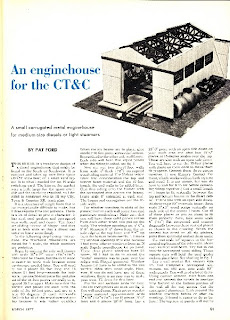 As you can see, the results are mixed, but I think it has its own charm with the attempt at a detailed interior. The roofless structure in the article’s opening page that allowed a view to the interior was what attracted me to this project. My interior and structure was crude, but it’s a interesting attempt.
 I’m still attracted by the idea of being able to look into and through a model. I recently finished the Overlook building and part of the attraction in building it was the possibilities it allowed for a viewable interior - hopefully, I’ll get some photos posted soon. I played with this idea a bit in model spacecraft too - with the Age of Discovery I wanted to be able to look into the ship, and in that project it took the form of a viewable shuttle-bay. I've still got the itch for looking into things, but I’m not sure where it might go from here; maybe a spacecraft with dual shuttle-bays so the viewer can look into them and through them into the ship - who knows.
 The enginehouse was also my first try at using E.L. Moore’s method for making metal panels from paper- the very same method I tried 30 years later in the Bunn's Feed & Seed and Jones' Chemical Company projects. However, I left out a very important step when I built this engine house: I didn’t actually emboss the corrugations over a form, but merely ran a ball-point pen over the paper. This gives a very limited effect, and doesn’t do justice to Mr. Moore’s method: the corrugations appear very flat. Back then I didn’t have any readily available sources for a suitable embossing form as I do today.
 I don’t think this engine house will appear on the layout. It’s still parked on the shelf for now.
 It’s been hectic lately and I haven’t done much building or posting. To help get back into the swing of things I thought I’d post a few pictures of some scratchbuilt structures I did back in the ‘70s - well, I’ll post pictures of the ones that have survived.
 Back in the day, my output was high, but the quality was low, probably due to inexperience, youthful exuberance, and maybe my choice of materials, which tended to wood, paper, and card since they were cheap and readily available. Of the ones that have remained, this is one of my favourites.
 This depot appeared as an article in the August 1975 issue of Railroad Model Craftsman called “On modeling the depot at Mineral City...” by Karl Naffin. For some reason I really liked the accompanying drawings and decided to build it; however, I was quite liberal in my interpretation of Mr. Naffin’s suggestions and recommendations on construction.
 I guess the thing that really dates this model - and me for that matter - is that all the siding and trim was made from used IBM computer punch cards my father brought home from work. I remember that it was very tedious cutting and gluing that siding to the structure. The tar paper roof is made from strips of masking tape, as are the window frames.
 The walls and roof are cut from regular craft-store bristol board and reinforced with 1/4-inch square balsa wood. Their inside surfaces were coated with shellac to help keep them from absorbing moisture - it seems to have done the job.
 Hopefully, this station will find a place on the new railroad.

 I haven't done much work on the railroad recently. I've been finishing off an entry for the Starship Modeler 'Just Glue It' contest. I submitted my two entries yesterday and hope to get back to layout building. After thinking about the above picture for awhile it's clear that last year was spent mainly on model building and not so much on layout building. Hopefully that'll change this year.
 I'm off on a bit of a tangent these days. I've got a few ideas for somewhat odd buildings made from leftover model kit parts and I thought I'd work on them for a while. This one is a tower to provide an overlook for curious train viewers. The top photo shows where I'm at in the construction, and the bottom photo shows the initial collection of parts. Once I'm finished building I'll list all the parts sources and highlights of the project.


